
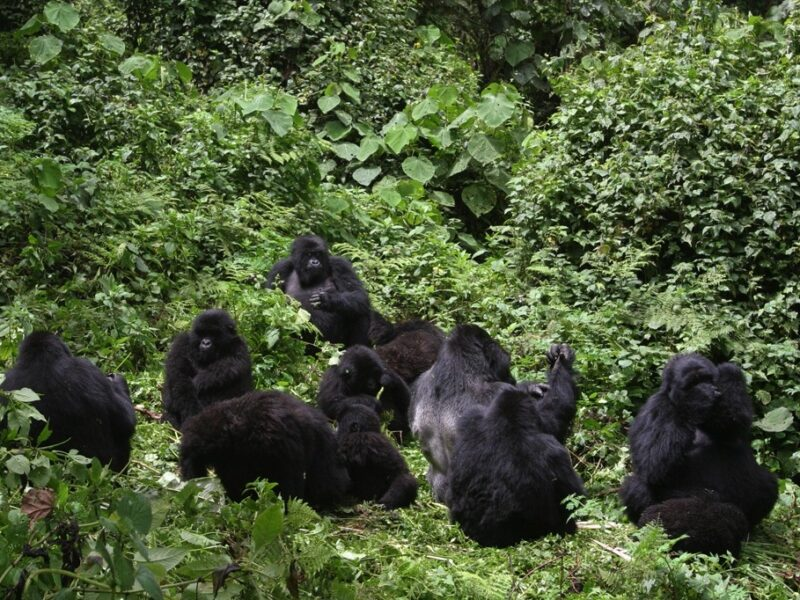
Features of Mountain Gorillas – Size, Strength & Life Guide 2026
Features of Mountain Gorillas: Mountain gorillas stand out as the largest primates on Earth, captivating wildlife enthusiasts with their majestic presence in Uganda’s lush forests.
Weighing up to 220kg for adult silverback males, these gentle giants embody raw power and intricate social bonds that define the features of mountain gorillas.
Found primarily in Bwindi Impenetrable National Park and Mgahinga Gorilla National Park, Uganda hosts nearly half of the world’s ~1,063 remaining mountain gorillas, making it the ultimate destination for gorilla trekking Uganda.
As a premier mountain gorilla safari operator, Rivo Safaris Uganda specializes in seamless, ethical treks that bring you face-to-face with these endangered icons.
Our expert guides ensure safe, immersive encounters while supporting conservation efforts. Discover the physical features of mountain gorillas, their family dynamics, and why booking a Bwindi gorilla trek with us guarantees an unforgettable adventure.
Join Rivo Safaris Uganda for a life-changing encounter—book your gorilla trekking tour today!
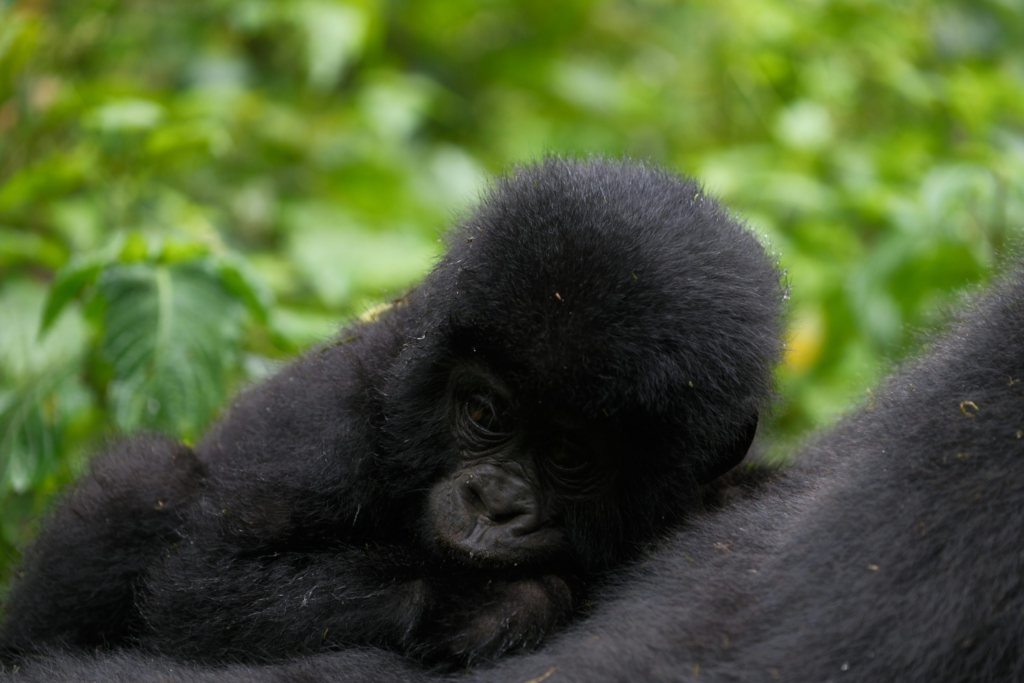
Physical Features of Mountain Gorillas
The physical features of mountain gorillas showcase evolutionary adaptations for survival in high-altitude habitats, distinguishing them from lowland gorillas with thicker fur and robust builds.
Adult male silverback gorillas, the troop leaders, reach heights of 1.7 meters when standing upright and tip the scales at 220kg, their massive frames supported by powerful muscles capable of lifting over 800kg—eight times their body weight.
Females, smaller yet equally impressive, average 1.5 meters tall and 97.7kg, with shorter fur that still insulates against chilly montane temperatures dropping to 10°C.
Their glossy black fur grows exceptionally thick on the back and arms, providing crucial protection in rugged terrains filled with thorny vegetation and misty rains.
Mountain gorillas boast 32 teeth, mirroring human dental structure, but with broader molars and strong jaws evolved for grinding fibrous plants comprising 99% of their diet.
These dental features enable them to process up to 30kg of vegetation daily, from tough bamboo shoots to succulent wild celery.
Their broad nostrils, prominent brow ridges, and sagittal crests—bony ridges on the skull anchoring massive jaw muscles—enhance sensory perception and feeding efficiency in dim forest understories.
For a quick overview of key mountain gorilla characteristics:
Explore stunning visuals of these traits in the Rivo Safaris Uganda photo gallery, capturing silverbacks in their natural glory during our guided gorilla safaris Uganda.
These physical features not only awe trekkers but underscore why Rivo Safaris Uganda prioritizes habituated groups for close, respectful viewing.
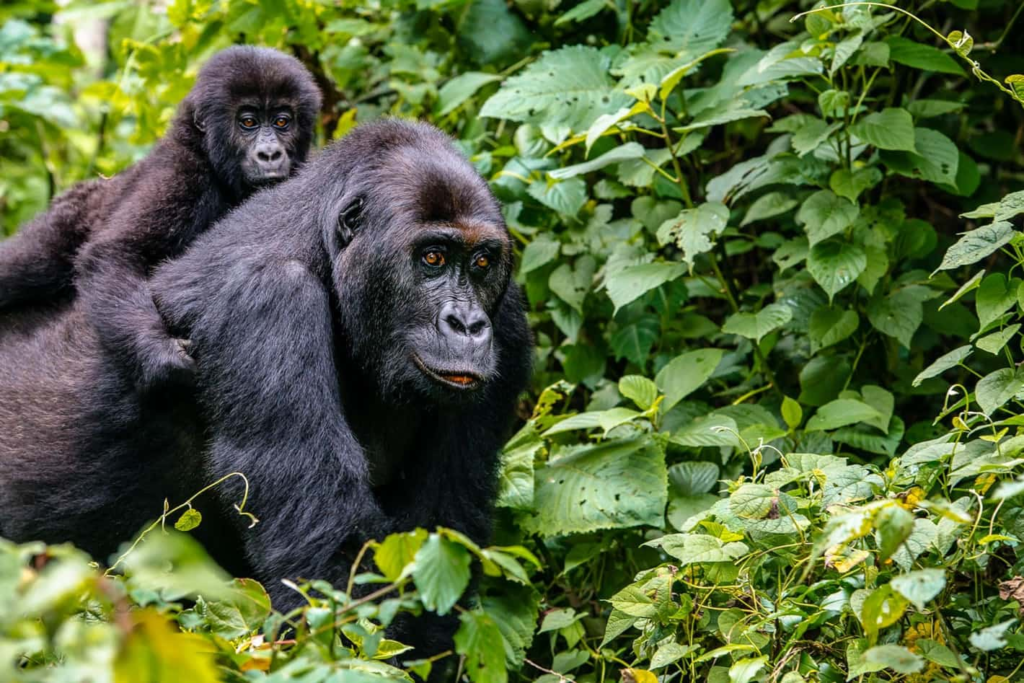
Social Structure
Mountain gorilla social structure revolves around cohesive family units called troops, typically ranging from 5 to 30 individuals, led by a dominant silverback gorilla whose authority maintains order and safety.
This patriarchal system ensures survival in predator-scarce yet resource-competitive forests, with the silverback making key decisions on foraging routes and nesting sites.
Females enter estrus every 2-3 years, gestating for 8.5 months before birthing a single infant, whom they nurse for up to four years—one offspring every 2-4 years due to long interbirth intervals that prioritise high juvenile survival rates exceeding 60%.
Strong family bonds define interactions: mothers dote on playful infants, while the silverback fiercely protects the group, charging intruders with thunderous roars and chest-beats.
Key roles include:
-
Silverback (leader): Vigilant patriarch, resolves conflicts, defends against rival males.
-
Blackbacks (sub-adults): 8-12-year-old males, learning leadership; support the silverback.
-
Adult females: Core nurturers, form lifelong bonds with kin.
-
Infants and juveniles: Playful learners fostering troop unity through grooming sessions lasting hours.
Disputes are rare, settled via grunts or slaps rather than lethal fights, highlighting their peaceful nature.
Rivo Safaris Uganda promotes treks to habituated families like the Nkuringo group in Bwindi, where visitors witness these dynamics up close—boosting your understanding of gorilla family structure while generating vital tourism revenue for conservation.
Our tailored mountain gorilla tours Uganda maximize these insights, ensuring ethical distancing and minimal disturbance.
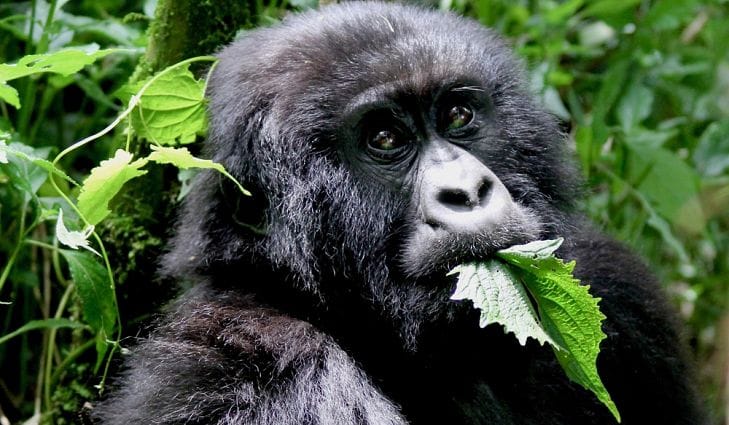
Habitat and Diet
Mountain gorillas thrive in misty montane rainforests between 2,000-4,300 meters, primarily Bwindi Impenetrable Forest (Uganda) and Virunga Volcanoes, where dense vegetation and frequent fog create a humid, equatorial climate averaging 20-25°C.
These ancient forests, UNESCO-listed for biodiversity, shelter over 400 plant species, providing ample forage amid steep slopes and bamboo thickets that challenge human trekkers but suit gorilla knuckle-walking.
Their herbivorous diet demands 26-34kg of vegetation daily, foraged over 300-800 meters: bamboo shoots (40% intake), wild celery, nettles, thistles, and fruit when seasonal.
Lacking predators beyond occasional leopards, they spend 50% of daylight feeding, using dexterous hands to strip bark or test soil for minerals.
Adaptations like knuckle-walking for efficient quadrupedal travel and climbing vines for access to higher foliage optimize energy in calorie-poor diets averaging 4,500 calories.
Rivo Safaris Uganda ties these habitat features to conservation, contributing to anti-poaching patrols and habitat restoration via trekking permit fees—over $700,000 annually to Uganda Wildlife Authority.
Our Bwindi gorilla safaris immerse you in this ecosystem, with guides explaining how tourism sustains endangered mountain gorillas against deforestation threats.
Behavioral Traits Features of Mountain Gorillas
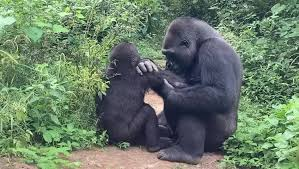
Despite their imposing size, mountain gorillas are gentle giants, exhibiting shy, intelligent behaviors that endear them to observers.
Highly social, they communicate via over 25 vocalisations—from soft grunts during grooming to explosive roars signaling alarm—alongside facial expressions, body postures, and olfactory cues via urine marking.
The iconic chest-beating display, performed by silverbacks 1-4 times hourly, uses cupped hands to produce resonant booms up to 1km away, asserting dominance without contact.
Studies reveal emerging tool use, such as sticks to gauge water depth or moss sponges for drinking, showcasing cognitive complexity akin to early hominids.
Daily routines include 14% resting, 30% feeding, and 6% traveling, with nightly nests built from bent branches. Their shy intelligence shines in habituated troops, where they tolerate humans at 7-meter minimums, often ignoring trekkers while playing or foraging.
Embed our Rivo Safaris Uganda of a silverback’s gentle family interaction—perfect for visualising behaviour traits of mountain gorillas on your Uganda gorilla trek.
Conservation Status
Mountain gorillas remain critically endangered, with ~1,063 individuals split between Uganda (half), Rwanda, and DRC, per 2023 IUCN assessments.
Primary threats include habitat loss from agriculture, charcoal production, and civil unrest fragmenting populations into isolated groups vulnerable to inbreeding.
Uganda’s trekking permits, priced at $800/person, fund 100% of protection efforts, employing 700+ rangers and boosting local economies. Success stories like Bwindi’s population doubling since 2000 highlight tourism’s role.
Rivo Safaris Uganda leads with eco-friendly tours, limiting group sizes to 8, enforcing “leave no trace” principles, and partnering with nonprofits—ensuring your gorilla trekking Uganda aids survival.
Trekking with Rivo Safaris Uganda
Experience 1-4 hour encounters with habituated troops, starting 7 AM from park headquarters. Secure an $800 permit via Rivo Safaris Uganda (book 3-4 months ahead, peak June-September).
Prep tips: Pack rain gear, sturdy boots, and gloves; moderate fitness for 2-7 hour hikes; porters available.
Secure your spot at rivosafarisuganda.com—tailored itineraries from 3-day treks.
Conclusion
Recapping features of mountain gorillas—from 220kg silverbacks and tight-knit troops to forest-adapted diets—these primates offer profound wildlife connections in Uganda.
Rivo Safaris Uganda transforms fascination into action through expert-led Bwindi gorilla treks.